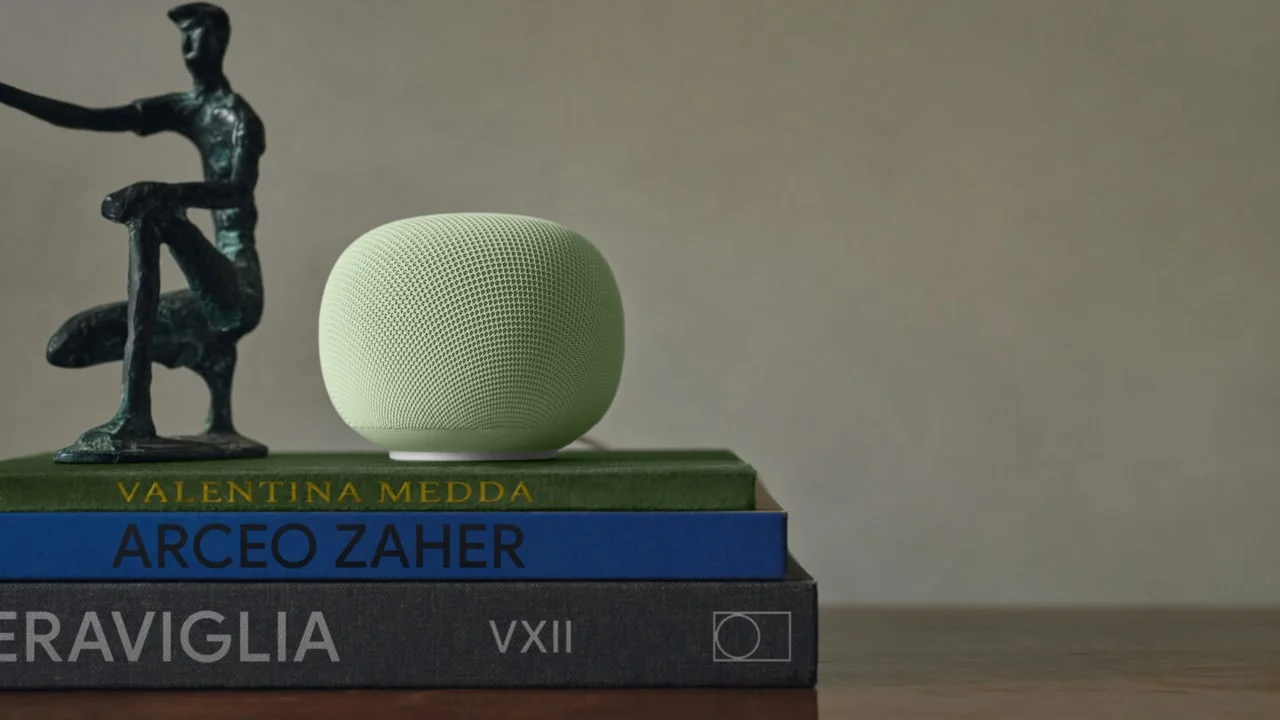
Google built a smart speaker. The house is the prompt.
Google Home Speaker is a useful Gemini-for-Home upgrade, but the real product is a $100 countertop onboarding device for Google Home Premium, household query history, and AI-training-grade home activity.

A smart speaker is just a chatbot that knows where you sleep.
On June 17, Google opened preorders for the Google Home Speaker, its first audio device built for Gemini for Home, at $99.99, with shelves slated for June 25. 1 TechCrunch describes it as Google's first standalone smart speaker since Nest Audio arrived in September 2020. 2 The pitch is tidy: stop memorizing smart-home incantations and just say the messy human version. "Turn off all the lights except for my bedside lamp." "Dim the kitchen lights, play some relaxing music, and set a timer for 20 minutes." Correct yourself mid-sentence and Gemini is supposed to follow. 1
That is the useful part. Old smart speakers often behaved like appliances with a filing cabinet for grammar. Google's new one wants to be a roommate with API access. The problem is that the roommate also comes with tiers.
The useful part is real
The Google Home Speaker is not just a Nest Audio with a Gemini sticker. Ars Technica reports a quad-core A55-based processor, a dedicated NPU, three far-field microphones, and local AI models for noise cancellation, echo suppression, and sound separation. 3 The Verge says Google has been improving Gemini for Home since the device was announced, including latency improvements for smart-home and media commands, fixes for more than 2,500 reported issues, and more than 50 feature improvements. 4
So yes, the product has a coherent reason to exist. Better microphones and local audio cleanup make sense in a kitchen, living room, or hallway. A speaker that can understand corrections is better than one that punishes you for saying the sentence in the wrong order. Continued Conversation, which keeps the microphone open briefly after a response so you can ask a follow-up without repeating "Ok Google," is a real usability improvement if it works reliably. 1
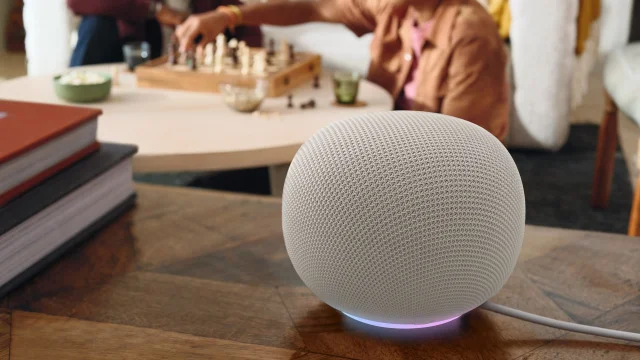
The hardware story gets less heroic once audio quality enters the room. Ars says Google told it the new speaker's audio quality will fall between the older Nest Audio and the smaller Nest Mini, even though the new device adds 360-degree sound and TV pairing tricks. 3 Translation: this is not really an audio upgrade. It is a voice interface upgrade wearing a fabric dome.
The bill arrives after the wake word
The $99.99 price is the door handle, not the room. Google's own store bundles six months of Google Home Premium with the speaker and says that trial unlocks Gemini Live, complex automation creation in the Google Home app, and more. 5 After that, the product splits into a familiar little subscription maze.
| Layer | What you get | The catch |
|---|---|---|
| Speaker purchase | Gemini for Home, media playback, broadcast, and parental controls are listed as included with the Google Home Speaker. 5 | The store FAQ says the speaker listens in standby for "Hey Google" or "Ok Google" unless you use the physical mic switch. 5 |
| Standard plan | Google Home Premium Standard is listed at $10/month or $100/year and adds Gemini Live, Help me create, and sound detection. 5 | The friend-like chat mode is not the baseline product. It is the paid one after the trial. |
| Advanced plan | Google Home Premium Advanced is listed at $20/month or $200/year and adds video history search and daily summaries. 5 | The more your home becomes queryable, the more the bill looks like infrastructure rent. |
| Camera intelligence | Google says Premium can let you ask the speaker about recent Nest camera activity and get Home Brief summaries of what happened around the house. 1 | The assistant stops being a speaker and becomes a search box for domestic surveillance footage. |
This is Google's old smart-home business with a better parser attached. The company spent years teaching people that a speaker is a cheap hub. Now the speaker is the handle for recurring AI features across cameras, automations, summaries, and audio detection.
The part that feels most Google is the phrasing. "Expert, hands-free help" sounds warm until the product page explains that the six-month trial is worth $60 and that after it ends you fall back to a more basic Gemini unless you pay. 5 A $100 speaker that trains you for six months to use paid voice features is not a gadget. It is onboarding hardware.
The room becomes queryable
Google does not hide the data bargain. Its support page for Gemini for Home says that when Voice Match is enabled and Home History is on, Google stores Gemini for Home activity in the user's Google Account, with activity saved for 18 months by default. 6 The same page says that when Home History is on, Google uses that activity to develop and improve its services, including training generative AI models. 6 Google also says a separate setting for improving services with voice, audio, and Gemini Live recordings is off by default and requires Home History to be turned on. 6
That last distinction matters. It is better than pretending every audio clip is fair game. But it still leaves the basic product logic intact: the more conversational the assistant gets, the more valuable the interaction history becomes. A command like "turn on the lights" was a switch. "What happened while I was out?" is a household narrative stitched from cameras, mics, timestamps, identities, rooms, and assumptions.
Guests get their own small footnote in the bargain. Google says that if someone interacts with a connected home device and the device does not recognize their voice, their activity may be stored in the device owner's Google Account. 7 Guest Mode can automatically delete audio recordings and voice assistant activity from the owner's account while it is on, but guests or owners have to turn it on first. 7
That is a weird social contract to hang on a kitchen counter. "Welcome to dinner, the pasta is almost ready, and please say a command phrase if you would rather not become a line item in my home history."
Verdict
The Google Home Speaker is probably the best argument Google has made in years for keeping a smart speaker around. Natural commands, mid-sentence corrections, better mic processing, and local noise cleanup solve real annoyances. If you already live inside Google Home, own Nest cameras, and want fewer syntax errors from the ceiling, this thing may earn its place.
But the honest product is not the $99.99 fabric pebble. It is a subscription path that turns the house into something Gemini can search, summarize, and monetize in layers. Google did not reinvent the smart speaker. It finally found a way to make the smart speaker ask for a monthly fee without sounding embarrassed.
References
- 1Meet the new Google Home Speaker, built for Gemini
- 2Google bets on Gemini to reinvent the smart home speaker
- 3Ten months later, the $100 Google Home Speaker is finally available for preorder
- 4Google's first smart speaker in six years arrives next week
- 5The Google Home Speaker, with Gemini
- 6Manage & delete your Gemini for Home activity
- 7Guests and your Google connected home devices
Add more perspectives or context around this Post.